BREAKING NEWS 15 minutes ago, At Washington D.C. —Barron Trump, son of President Donald J. Trump, has tragically passed Awa See more
Trump Faces Multiple Federal Charges Over 2020 Election Efforts
On Thursday, former President Donald Trump was formally charged with four criminal counts tied to his actions following the 2020 presidential election. The charges include conspiracy to defraud the United States, conspiracy to obstruct an official proceeding, obstruction and attempt to obstruct an official proceeding, and conspiracy to violate civil rights protected by the Constitution.
These charges stem from Trump’s alleged efforts to overturn the results of the 2020 election and disrupt the certification of electoral votes by Congress on January 6, 2021. The indictment marks another significant legal challenge for the former president, who remains a central figure in American politics as he campaigns for the 2024 GOP nomination.
Prosecutors argue that Trump knowingly spread false claims of election fraud, pressured officials to ignore lawful vote counts, and encouraged schemes aimed at delaying or invalidating the certification process.
Despite mounting legal troubles, Trump has denied wrongdoing and labeled the investigation a politically motivated “witch hunt.” His legal team has vowed to fight the charges in court, calling them an attack on free speech and the democratic process.
The indictment does not accuse Trump of inciting the Capitol riot directly but highlights his alleged role in a broader conspiracy to interfere with the democratic process and disenfranchise millions of voters.
This case, brought by special counsel Jack Smith, is the third criminal indictment against Trump this year. It adds to growing scrutiny surrounding his post-presidency conduct and efforts to return to the White House.
Reactions have been deeply divided. Critics call the charges necessary for accountability, while supporters see them as further evidence of bias against Trump.
As the legal battle unfolds, the nation watches closely. Trump’s political future—and the justice system’s ability to navigate unprecedented territory—now hang in the balance.
C Legal Storm Intensifies for Trump With New Criminal Indictments
It has been nearly a year since the chilling and jaw-dropping moment in Butler, Pennsylvania, when a would-be assassin opened fire at then-presidential candidate Donald Trump. This moment, which many feared could have been fatal, became a defining chapter in Trump’s political comeback as he overcame the terrifying assassination attempt. In an exclusive excerpt from the upcoming book
2024: How Trump Retook the White House and the Democrats Lost America, obtained by The Washington Post, Trump shared his perspective on the events that followed the shooting, revealing just how close he came to death.

The book explores not just the immediate aftermath of the shooting, but the long-lasting impact it had on Trump’s image, his political fortunes, and his relationship with former critics. This assassination attempt, which took place on July 13, 2023, set the stage for a remarkable transformation in Trump’s campaign.
The Butler Assassination Attempt: A Close Call
A Bullet Fired at Trump
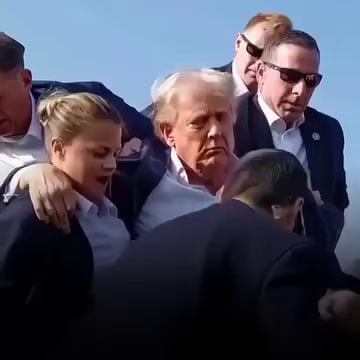
On that fateful day, Trump had just stepped off the stage at a campaign rally in Butler, Pennsylvania, when a sniper, 20-year-old Thomas Matthew Crooks, took aim at the former president. Positioned on a rooftop about 100 yards away from the rally, Crooks fired at Trump. The shot rang out, sending immediate shockwaves through the crowd and the Secret Service. Trump was caught in the crosshairs of a life-threatening assassination attempt.
In an extraordinary display of professionalism and quick action, Secret Service agents immediately rushed Trump, tackling him to the ground and securing him away from the sniper’s line of fire. They quickly evacuated him from the venue, and the chaos that ensued was the stuff of nightmares. The attack on Trump was the last thing anyone had expected, yet it happened so suddenly and with such precision that even those closest to him feared for the worst.

The book reveals that, despite the severity of the situation, Trump was surprisingly composed. “Trump was sitting up in bed, still wearing his suit. A bandage covered his ear. There was blood everywhere,” the book recounts. The amount of blood was so severe that even his closest aides were convinced that Trump had been shot multiple times. The bleeding was intense and far beyond what anyone had anticipated, which led to serious concerns about his condition.
Trump himself later recalled the harrowing experience, commenting in an interview that the blood loss was so substantial that it almost felt like he was losing control. “It was bleeding like a b****,” Trump said, referring to the amount of blood he was losing. However, despite the traumatic events and the grave situation, Trump showed a level of resilience that was almost unexpected.
The Humor That Followed: Trump’s Resilience in the Face of Danger

One of the most striking aspects of Trump’s recovery was his ability to inject humor into the situation, even in the face of danger. Within hours of the assassination attempt, Trump began making jokes, lightening the mood in what could have been a grim and somber hospital room. His aides, who were initially shaken by the gravity of the situation, began to relax when they realized Trump was alive and in relatively good spirits.
According to the book, this was a defining moment for Trump’s resilience. “They realized he was alright because he started making jokes,” the authors write. His ability to regain his sense of humor, even in the midst of such a traumatic event, reflected his mental strength and determination to survive. This humor became a hallmark of his recovery, and his aides quickly saw that Trump’s toughness extended beyond just his physical survival—it was a mental and emotional strength that helped him recover.
Trump’s Comeback and the Transformation of His Campaign
From Candidate to Survivor
What was initially seen as a near-fatal event quickly became a cornerstone of Trump’s political comeback. In the days that followed the assassination attempt, Trump’s image shifted dramatically. He was no longer just a candidate seeking re-election; he had become a survivor of a potentially fatal attack. This brush with death, coupled with his remarkable recovery, reinvigorated his supporters and even drew praise from his former critics. The assassination attempt added a new dimension to Trump’s public persona. He was no longer just another political figure—he had become a symbol of survival, resilience, and perseverance.

Trump himself reflected on the close proximity of the shot during an interview. “130 yards is like sinking a one-foot putt,” he said, referring to the sniper’s distance. “It’s considered really close,” he continued, emphasizing just how close he came to death. The fact that he was able to survive such a close-range attack only added to the narrative of his political comeback, making him a more formidable figure in the eyes of both supporters and detractors.
The Impact on His 2024 Campaign
In the wake of the shooting, Trump’s campaign took on a new tone. The narrative was no longer solely about policy or rhetoric—it was about survival. His strength in the face of adversity became a major talking point. His supporters rallied behind him, viewing him as a figure who had not only withstood a deadly attack but had emerged even stronger for it. The symbolism of his survival resonated deeply with his base, who saw it as evidence of his resilience and determination.
Additionally, Trump’s recovery process and his response to the assassination attempt marked a turning point in the 2024 election race. His campaign, which had initially been struggling to gain momentum, saw a surge in support as people rallied around his story of survival. The moment of his near-death experience became a powerful symbol, solidifying his place in the race and giving him a renewed sense of political legitimacy.
Unexpected Support from Former Critics

What was even more surprising, however, was the shift in attitude from some of Trump’s most vocal critics. Figures like Jeff Bezos, the founder of Amazon, and Mark Zuckerberg, the CEO of Facebook, had long been antagonistic toward Trump. However, after witnessing his survival of the assassination attempt, both men publicly reassessed their views of the former president.
Bezos, in particular, was quoted as saying that Trump’s instincts showed who he was as a person. “Bezos said Trump’s instincts showed who he was, and he wanted them to have a friendship,” the book reveals. For many observers, this marked a dramatic shift in the political landscape. Some of Trump’s fiercest critics were now reaching out, acknowledging his strength and resilience.
Zuckerberg, too, was impressed by Trump’s ability to recover from such a traumatic event. Describing the moment when Trump pumped his fist in the air after the shooting, Zuckerberg remarked that it was “one of the most badass things” he’d ever seen. This unexpected support from two of Silicon Valley’s most influential figures illustrated just how transformative the assassination attempt had been for Trump’s public image.